Wednesday, August 14, 2013

Stopping to look in the digital age

Last night, I was working on a new component of a piece I'm making with a found address book. I thought I'd give myself the challenge of not looking up a reference image from the internet. Luckily I've got plenty of bird guides to look at:

Clockwise from left: Audubon Guide, Golden Guide, Sibley Guide (Eastern edition), my sketchbook.
But I still failed at the one rule I'd set for myself! I ended up looking at pictures of diving falcons on Google, and basing a big part of the image on what I found.

I realized this year that I'm pretty attached to the use of the internet as a way of finding reference images and information. I have mixed feelings about this. On one hand, I find inspiring articles that become seeds for new pieces (like this one), I can find images of pretty much anything I want, and I can research content through great sites like the Cornell Lab of Ornithology. On the other, I'm becoming very dependent on using photos to draw things that aren't right in front of me (like birds), which attaches me physically to needing computer access to work, and opens up the big portal to extreme internet distraction, something I admittedly have a really hard time avoiding. I start at Cornell Lab of Ornithology and wind up on Cute Overload, or worse, facebook, in a matter of minutes. I've thought about installing some software to just block out the websites I find distracting, but thought it might be a better long-term habit to cultivate my ability to make drawings without any internet-aided visual references. After all, I somehow made it 21 years without relying on it, and so did everyone before the 2000s.

Artists in the past would produce notebooks full of copies and sketches of the "building blocks" of paintings - faces, drapery, putti, landscapes - because in a world where images were rare and there wasn't an internet, or even many books with images, your own drawings and memory became your best reference. A favorite example of mine is Da Vinci's sketchbook page of cats, drawn from life, with a fanciful dragon thrown in, clearly not:
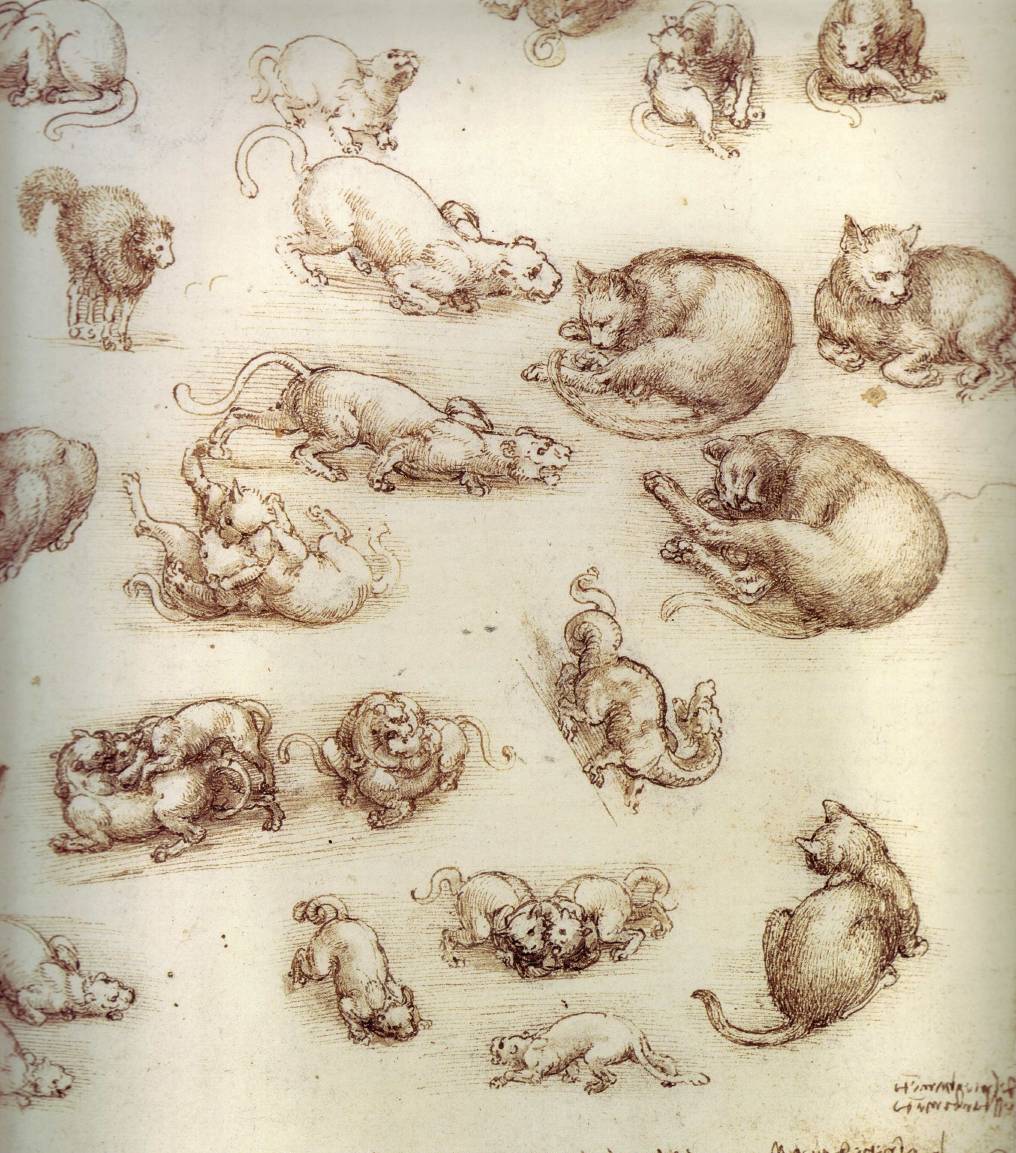
Image from www.drawingsofleonardo.org
The dragon is just as beautifully drafted as his from-life studies, thanks to a combination of acute powers of observation, incredible drafting skill, and vivid imagination. The greatest painters - Da Vinci (more of his work here), Michelangelo, Rembrandt - all have the amazing ability to turn snippets and sketches from real life into fantastic, completely invented scenes. A lifetime of close observation - the kind dedicated artists achieve - gave them the power to trust their own drawings, and their own judgment, without an object in front of them. The visual and muscle memory came from inside, and I've always been awed by that. It's something I'm still learning.

I wonder how many other artists who are as wedded to technology and photos as I've become struggle with this dependency. Or if people feel that it's a bad thing in the first place. Art is art, and if the audience can't see the process and the finished piece is more or less the same either way, is it really any nobler to take the more difficult road? Do I "see" less completely or less deeply because I'm looking at a photo, and not an object or a drawing I'm copying, or inventing everything entirely? At what point do you trust your own marks and stop thinking about whether it looks enough like the image on which you're basing it? These questions are at the heart of how artists interpret the world through their draftsmanship. To a degree, they're permanently debatable, but I think searching for some answers is the next step the improvement of my technique will have to take.

Saturday, July 27, 2013

White Nose news

Somewhat hopeful news is on the front for White Nose Syndrome, the mysterious and deadly disease that has been wiping out bats across the United States. Scientists have isolated and named several close relatives of the fungus thought to be infecting the bats, Geomyces destructans.

"According to a new report in the journal Fungal Biology, biologists from the US Forest Service have identified several benign relatives of the fungus that is believed to cause the disease.

'Identification of the closest known relatives of this fungus makes it possible to move forward with genetic work to examine the molecular toolbox this fungus uses to kill bats,' said study co-author Daniel Lindner, a research plant pathologist with the Forest Service. 'Ultimately, we hope to use this information to be able to interrupt the ability of this fungus to cause disease.' "

Important information to uncover - bats are essential in keeping insect populations in check. We don't have much time to lose.

Relatives of White Nose Syndrome Found, May Help Find a Cure

Monday, July 22, 2013

"Herb Experts" radio spot is up and ready for the listen

My friend Erika May - also a classmate of mine from Carnegie Mellon University - produces the terrific kids' radio program Saturday Light Brigade, and recently interviewed me and some other folks about the use of herbs in our life for a series called "Herb Experts."

Erika spoke with a great variety of folks using and appreciating herbs in their daily lives, including health professionals, cosmeticians, gardeners, farmers, and people like me, who have a real passion (obsession?) for cooking. I talked about my cookbook, A Time to Eat, which I wrote as a fundraiser and introduction into the world of fresh-food cooking for the exhibition A Matter of Convenience. (I'm still selling copies, so if you'd like one, just shoot me an email at maria [dot] mangano [at] gmail [dot] com. They're $10 plus shipping.)

You can listen to everyone's interview here at this link. I'm about halfway down the page.


Monday, June 10, 2013

Almost ready!

Here I am installing "hibernaculum" at LOCUS Artspace, as part of the Americans for the Arts Conference's ARTventure tours on Saturday:


. . . I brought way more bats than I needed!

The tour stop at LOCUS features the work of many terrific artists, and a few of my other pieces as well. Registration for the AFTA conference is required to sign up for the tour, so if you aren't able to do that, there will be an open house on Sunday, June 16th, from 2pm to 5pm. LOCUS Artspace is located at 431 Dargan Street, just off the Bloomfield Bridge.

Tuesday, May 7, 2013

Handmade in PA interview hits the interwebs

A friend and fellow alumna, Carrie Hamilton Barlup, writes for the Handmade in PA blog and interviewed me for a series on artists. The interview is currently up on the website!

Read it here:

Inspired by... Maria Mangano

Monday, April 22, 2013

CHAIR-ity Benefit photos

Here are some photos of the chair I made for the Mt. Lebanon Library Fundraiser last week. I'm a lover of both reading and birds, so of course I had to combine them in my piece, "Words of a Feather" (cue the groans):


All of the birds featured appear in books throughout history - everything from the dove in the Torah to the dodo Alice in Wonderland.


I tried to be diverse in both genre and bird species. A favorite of mine is below - Jurassic Park.


Everyone from professional artists to hobbyists and organizations decorated chairs. Here are some of my favorites.

Sam Ditch, For Glitter Mountain's Majesty:

Lucy Jones and Alicia Koloski, Armchair Philatelist:

A big group of artists, Children's Imagination:

Jessica Turner and Nina Barbetti, Spring Forest:

Mary Dornenburg, Artist's Studio Chair:

 I didn't get the artist's name on this one, but the title is You Can't Get There From Here:


Wednesday, April 17, 2013

New work in progress

With spring arriving, I've been working on the latest printing of my cookbook (more on that later!) as well as some new work. Here's a snippet of my project for the Mt. Lebanon Library's CHAIR-ity benefit (I'll post photos of the whole piece later so as not to spoil the surprise):


I'm also making some new small mixed-media pieces. I was lucky enough to choose a present in a white elephant exchange last December that turned out to be a mid-century fancy address book, complete with very old (pre-seven-digit) phone numbers. I've been making small drawings on each page. Here are the first three.

Passenger pigeon


Laysan crake


Moa


All three were driven to extinction at various times in human history, either due to overhunting or habitat loss. Not all of the animals in this series will be birds - or extinct - but these are the first three I was inspired to do. They're all a combination of gouache, graphite, and watercolor.